


May 3, 2026
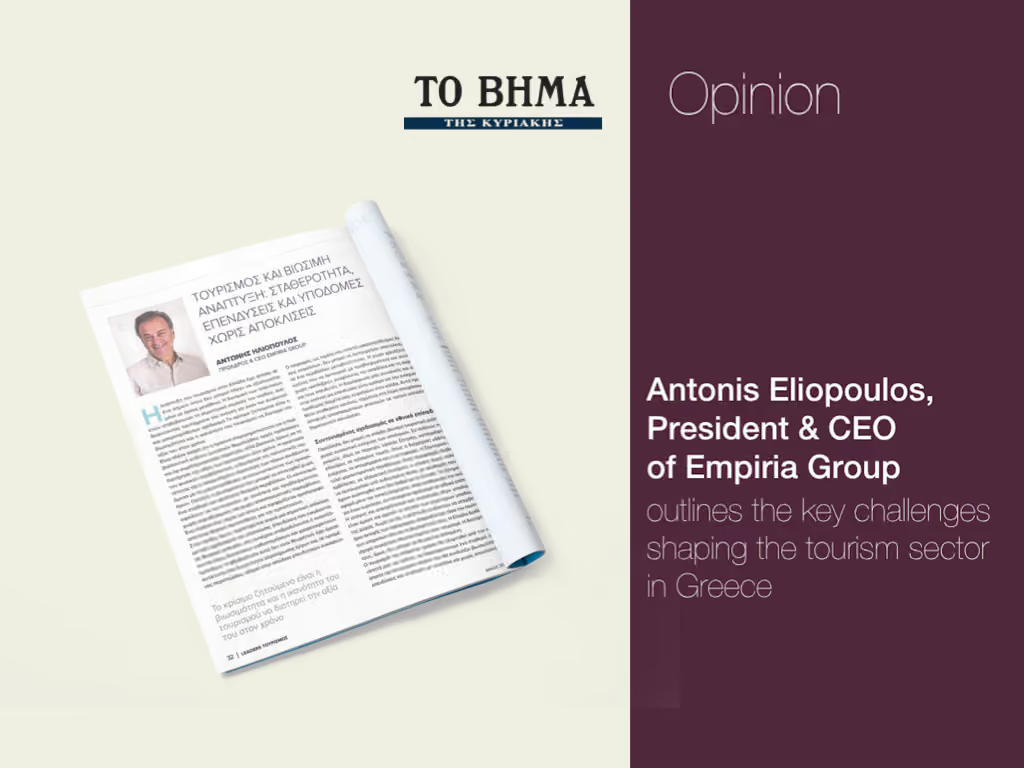
Antonis Eliopoulos, President & CEO of Empiria Group, shares his perspective on the evolving landscape of Greek tourism, highlighting the importance of sustainability, investment consistency and infrastructure as key pillars for long-term growth. His article was published in the “Leaders – Tourism” edition, released with To Vima tis Kyriakis on Sunday, May 3.
Tourism and sustainable development: stability, investment and infrastructure in a consistent framework
The development of tourism in Greece has reached a point where it can no longer be assessed solely in terms of scale. The momentum of recent years confirms the sector’s strategic importance, while simultaneously highlighting the need for a more cohesive and long-term planning approach.
The key challenge is sustainability and tourism’s ability to preserve its value over time.
It is now clear that green entrepreneurship and environmental responsibility are not complementary practices, but fundamental principles of planning and essential conditions for maintaining the long-term value of destinations. The protection of the natural environment, the preservation of cultural identity, and the balanced use of resources are directly linked to the long-term competitiveness of destinations.
The need for stability and institutional consistency
However, sustainability cannot be achieved without a stable and reliable institutional framework. Regulations must operate with consistency and predictability, without sudden changes or fragmented interventions. A framework that applies equally to all and is implemented uniformly is a prerequisite for building trust.
In practice, however, a significant gap is often observed between planning and implementation. Investments that receive institutional approval are frequently delayed or suspended due to administrative bottlenecks and bureaucratic obstacles. This uncertainty is not theoretical; it has a direct impact on the completion of projects and, in some cases, leads to the loss of investment opportunities.
Tourism, as a sector that requires long-term capital commitments, cannot function effectively in an environment of volatility. The country needs a state that operates with predictability and consistency, without surprises, strengthening security and clarity for investors.
Creating a coherent and reliable investment landscape is crucial for encouraging capital inflows into the sector. This requires stable rules, speed in decision-making, and the avoidance of fragmented local-level interventions that create inconsistencies.
Infrastructure as the foundation of sustainable growth
At the same time, sustainable tourism development cannot exist without substantial investment in infrastructure. In many destinations particularly those with high demand there are clear deficiencies in critical areas such as water management, energy, waste systems, and transportation.
Santorini is a characteristic example. A destination of global reach and exceptional potential, yet one that operates under increasing pressure, with infrastructure that has not evolved at the same pace as demand. This is not merely a local management issue but highlights the need for broader, coordinated planning at a national level.
The need to redesign and implement new infrastructure is immediate and concerns the country’s broader systems as a whole. Without it, growth risks exceeding the carrying capacity of destinations, affecting both service quality and long-term sustainability.
Greece holds strong comparative advantages in tourism. However, their preservation cannot be taken for granted.
The tourism of tomorrow will depend on our ability, as a country, to establish a stable, reliable, and functional framework, one that consistently integrates sustainability, investment, and infrastructure without deviations.



