October 29, 2026
A closer look at the challenges and opportunities shaping Greece’s tourism investment landscape, through a discussion on spatial planning, legal certainty and the future of responsible hospitality development
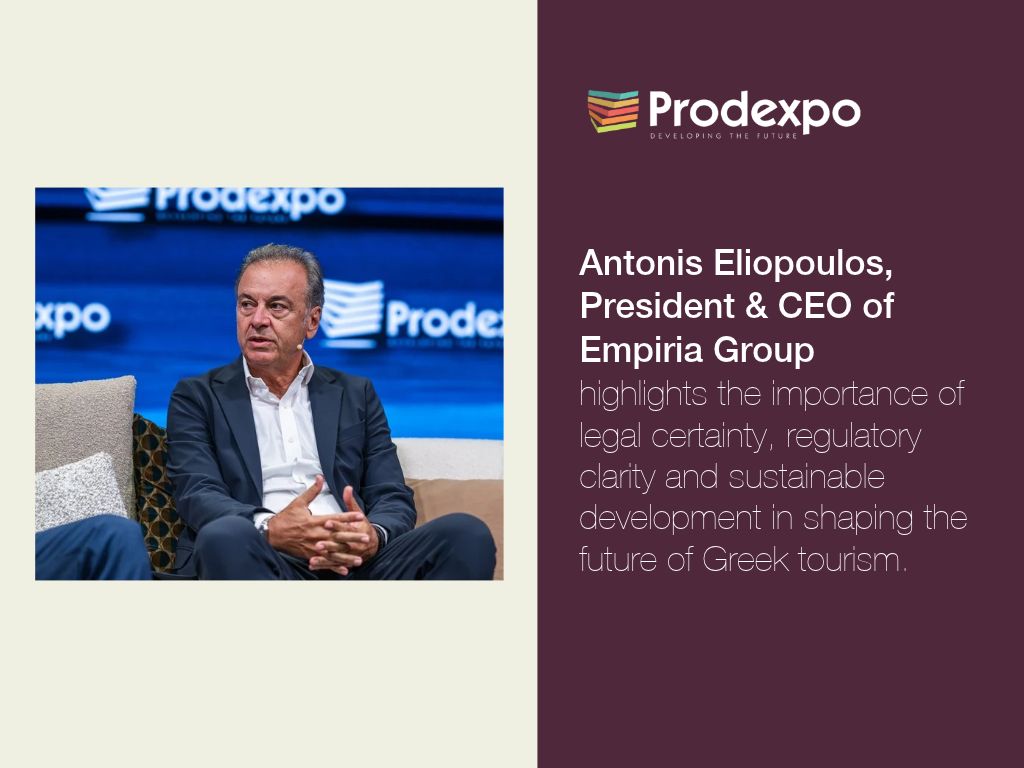
Antonis Eliopoulos, President & CEO of Empiria Group, participated in Prodexpo 2026 on October 15, contributing to a discussion on Greece’s evolving tourism spatial planning framework and the conditions required to support responsible investment and long-term growth in the hospitality sector.
Titled “Greece’s New Tourism Zoning Plan: Reshaping the Country’s Heavy Industry,” the panel brought together representatives from the public and private sectors to examine the opportunities and challenges shaping the future of tourism development in Greece.
Moderated by Kostas Panagakis, Principal of Travelworks, the discussion featured Petros Varelidis, Secretary General at the Ministry of Environment and Energy; Giorgos Spanos, Vice President & CEO of Domes Resorts; Lila Tsitsogiannopoulou, Director of Real Estate Advisory at PwC; and Stelios Koutsivitis, President of SWOT Hospitality.
Drawing on his extensive experience in developing and transforming hospitality properties, Mr Eliopoulos highlighted the importance of establishing a clear, consistent and predictable regulatory environment for tourism investments. While acknowledging the necessity of spatial planning regulations and their role in safeguarding destinations, he addressed the practical challenges that arise from complex licensing procedures and the uncertainty surrounding the implementation of local spatial plans.
A central point of his contribution was the importance of legal certainty throughout the investment process. Mr Eliopoulos explained how projects that have secured the necessary administrative, environmental and planning approvals may still face unexpected suspensions, even after construction has commenced. Such developments create significant challenges for investors, particularly when substantial financial commitments and contractual obligations are already in place.
He also addressed the wider implications of regulatory uncertainty for investment financing, emphasizing the importance of a stable framework that allows developers, financial institutions and investors to plan with confidence. In this context, he highlighted the need for greater coordination between public authorities and consistency in the application of existing regulations.
Environmental protection and sustainability were equally important aspects of his intervention. Mr Eliopoulos reaffirmed the necessity of responsible tourism development, recognizing that the preservation of natural resources and the distinctive character of destinations must remain central to future planning decisions. At the same time, he emphasized that environmental responsibility and investment certainty should not be viewed as competing priorities, but as complementary elements of a well-structured development framework.
Throughout the discussion, Mr Eliopoulos advocated for clearly defined regulations, timely administrative decisions and a consistent approach to their implementation, underscoring the importance of a framework that supports both sustainable development and investor confidence.
His contribution to Prodexpo 2026 highlighted the need for a balanced approach to Greece’s tourism development, one that combines environmental responsibility with regulatory clarity and long-term investment stability, creating the conditions for a more resilient and sustainable hospitality sector.