


October 29, 2026
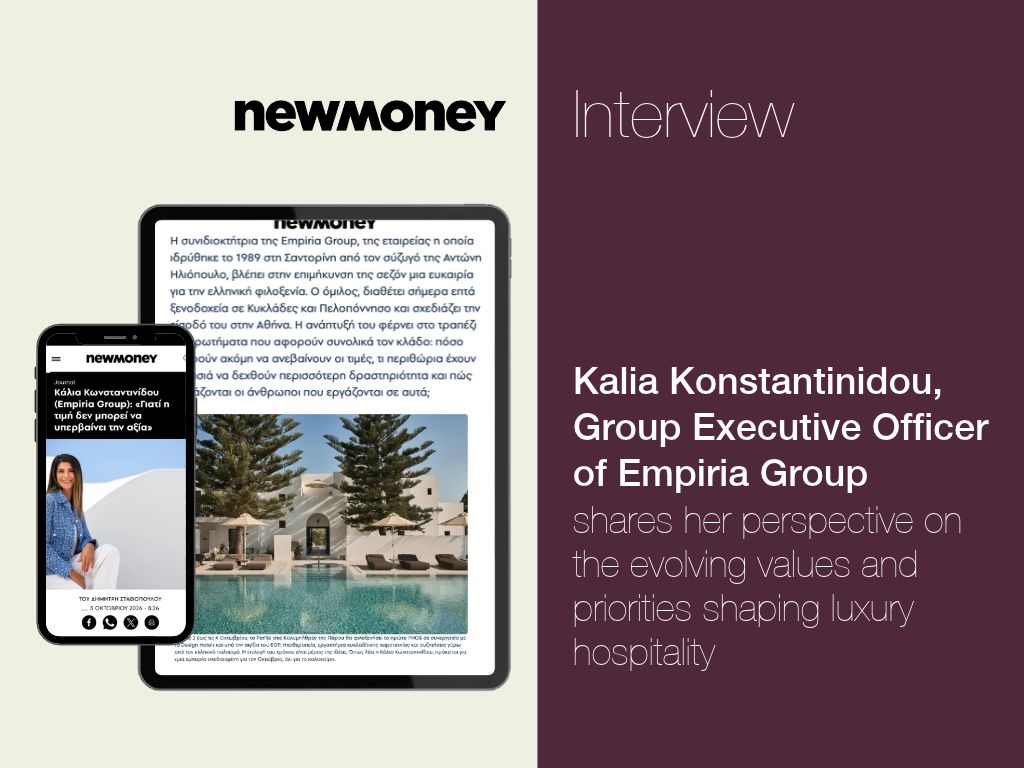
In a feature for Newmoney, Kalia Konstantinidou, Group Executive Officer of Empiria Group, shares her insights on the future of luxury hospitality, the balance between value and experience, and the importance of responsible growth.
Kalia Konstantinidou: “Why Price Cannot Exceed Value”
The co-founder of Empiria Group discusses pricing in luxury hospitality, the pressures facing the Cyclades, accommodation for seasonal employees, and the cost of “conscious luxury.”
The co-owner of Empiria Group, a company founded in Santorini in 1989 by her husband, Antonis Eliopoulos, sees the extension of the tourism season as an opportunity for Greek hospitality. Today, the Group operates seven hotels across the Cyclades and the Peloponnese and is planning its entry into Athens. Its expansion also raises questions affecting the hospitality industry as a whole: how much further can prices rise, how much additional tourism activity can the islands accommodate, and where will the people working on these islands live?
From October 2 to 4, Parīlio, located near Kolymbithres in Paros, will host the inaugural PHOS event, organized in collaboration with Design Hotels and under the auspices of the Greek National Tourism Organisation. The programme will include sound healing, Cycladic craftsmanship workshops, and discussions exploring Greek culture. The timing is an integral part of the concept. As Kalia Konstantinidou explains, it is “an experience designed for October, not for summer.”
When Price Exceeds Value
In luxury hospitality, the discussion around pricing extends far beyond the cost of a room. Guests evaluate the service, the food, and everything they encounter beyond the hotel itself. They also compare Greek destinations with alternatives in other countries.
Konstantinidou links the evolution of Average Daily Rate (ADR) to the value guests perceive and receive. She believes Greece possesses significant natural and cultural assets, but its competitiveness against destinations such as Italy and Turkey “cannot be based solely on increasing prices.”
Investment is needed in people, infrastructure, and the preservation of each destination's distinctive character. “I don't believe there is a specific ‘ceiling’ on prices,” she says. “There is, however, a limit to how much prices can increase without a corresponding increase in value.”
The Cost of “Conscious Luxury”
“Conscious luxury” is a central concept in the way Empiria presents itself. We asked Konstantinidou what the term means beyond describing a guest experience, and whether its cost can be quantified.
She defines it as “an operational choice that runs through the entire lifecycle of a project,” from design and material selection to hotel operations and partnerships with local producers.
She acknowledges that the initial investment is often higher. However, she does not provide a specific figure indicating how much this approach increases the investment per room. In her view, the additional cost pays off over the long term through the business's competitiveness and the destination's resilience.
The question is whether guests are willing to pay more for this approach.
“They pay a premium not explicitly ‘for sustainability,’ but for its outcomes,” she explains.
She acknowledges that, for part of the market, sustainability remains a desirable feature rather than a decisive factor. “For the audience we cater to, it is gradually becoming a prerequisite.”
The Group has published its 2025 Impact Report. However, when the discussion turns to the percentage of revenue or capital expenditure allocated to sustainability, Konstantinidou does not provide a specific amount.
She maintains that sustainability “is not a budget line; it is a design criterion,” referring to materials, energy, partnerships with producers, and initiatives supporting local communities.
Development on Islands Under Pressure
The discussion takes on greater significance when it comes to investment in the Cyclades. The same islands attracting growing interest from the luxury hospitality sector are facing increasing pressure on their infrastructure, repeatedly bringing the issue of carrying capacity to the forefront.
Kalia Konstantinidou describes overtourism as a genuine challenge for many Greek destinations.
She explains that, before undertaking any new investment, the Group examines whether a project can be integrated into its surroundings without altering the destination's character and what it can contribute to the local community.
When it comes to managing demand, she places particular emphasis on infrastructure, which must adequately serve both visitors and those who live on the islands throughout the year.
Within this context, she also highlights initiatives such as PHOS, which aim to connect the visitor experience more closely with the destination.
“The success of a hotel group should not be measured solely by the number of guests it welcomes, but also by what it leaves behind,” she notes.
Ultimately, what each investment leaves behind is also the most demanding aspect of this position.
October as a Test Case
PHOS will make its debut in Paros and, according to Konstantinidou, will subsequently expand to other hotels withinthe Group, featuring different content at each location.
She believes it is still too early to assess the initiative's financial performance.
“We are still in the first chapter, and I believe it is premature to discuss a specific return-on-investment timeframe.”
The choice of October also reflects a broader shift in demand that she has observed.
She believes the traditional model of island hotels relying almost exclusively on July and August is beginning to change.
Santorini, she points out, was among the first destinations to extend its tourism season beyond the peak summer months.
At the same time, increasingly intense summer heat is encouraging some travellers to choose spring and autumn instead.
A longer tourism season can distribute visitor numbers across more months and provide employment for a greater part of the year.
It does not, in itself, resolve the challenges facing the islands. It does, however, demonstrate why October is increasingly attracting the interest of hoteliers as a month of activity in its own right, rather than simply the closing chapter of summer.
Housing for Seasonal Employees
For a hotel group in which nine out of ten employees are seasonal, extending the tourism season is inevitably linked to working and living conditions.
On islands where available housing is often limited and expensive, providing accommodation for employees requires significant resources.
“The guest experience begins with the experience of the people who work within the Group,” Konstantinidou says.
According to her, Empiria invests in accommodation for seasonal employees, working conditions, equal pay for equal work, and opportunities for professional development.
However, her response does not specify how many employees benefit from the Group's housing arrangements or
what form these arrangements take.
She also refers to the Group's 2025 employee survey: 82% of respondents said they felt part of the team, 75% felt their work was recognised, and 72% reported having opportunities for personal and professional development.
These figures reflect the employee experience rather than the adequacy of housing provision. Nevertheless, they help explain why the Group connects the retention of stable teams with the quality of service it delivers.
From the price of a hotel room to the home of a seasonal employee, the discussion ultimately returns to the same question: what must underpin a more expensive hospitality experience?
Her answer is that prices can continue to rise as long as the value offered rises alongside them.
For hotels and the destinations in which they operate, that value must ultimately be demonstrated in practice.



